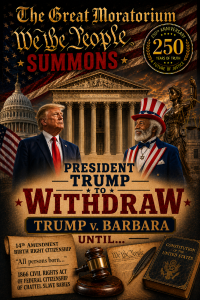
 THE APPEAL FOR THE GREAT, 14th AMENDMENT MORATORIUM
A Letter to the President of the United States
June ____2026
The Honorable Donald J. Trump
President of the United States
The White House
1600 Pennsylvania Avenue, N.W.
Washington, D.C. 20500
Dear Mr. President,
As America approaches the 250th Anniversary of the Declaration of Independence, I respectfully write to you concerning what may be one of the most significant constitutional opportunities of our generation.
This letter is not written in opposition to your Administration.
It is not written to challenge your authority as President. Nor is it written to criticize your efforts to secure the nation’s borders or enforce the laws of the United States.
Rather, it is written in the hope that history may have placed before you an opportunity greater than a courtroom victory.
At this moment, the Nation finds itself engaged in a heated debate concerning citizenship, immigration, constitutional identity, and the meaning of the Fourteenth Amendment.
The controversy surrounding Trump v. Barbara has brought these questions to the forefront of American life. Citizens, scholars, judges, elected officials, and ordinary Americans now find themselves discussing issues that touch the very foundation of the Republic.
Yet amid all the debate, one question continues to present itself to thoughtful observers across the Nation:
What if America, We the People, have been asking the wrong constitutional question?
For generations, public attention has focused upon the phrase, “All persons born or naturalized in the United States, and subject to the jurisdiction thereof.” Entire theories have been constructed upon those words. Court decisions have relied upon them. Political movements have organized around them.
Yet remarkably little public attention has been devoted to the constitutional history that preceded them, including the Civil Rights Act of 1866, the Reconstruction debates, and the extraordinary circumstances that followed the Civil War.
Reasonable people may disagree about the significance of those matters.
Yet it is difficult to argue that they are unimportant. Indeed, many Americans are now discovering that they have never been encouraged to examine some of the most important constitutional events that gave rise to the Fourteenth Amendment itself.
That realization has led many citizens to ask whether a period of national examination should precede a final judgment of historic consequence.
A Lincoln-like, Presidential Opportunity
Mr. President, not every President is given the opportunity to influence the constitutional direction of the Nation during a milestone as significant as the 250th Anniversary of American independence.
The generation of Washington established the Republic. The generation of Lincoln preserved the Union.
The Reconstruction generation attempted to secure the promises of freedom through constitutional law.
Now, during the 250th year of the American experiment, another generation finds itself confronting questions rooted in that same constitutional story.
History occasionally presents moments when leadership requires something more than action. It requires reflection. It requires patience. It requires the confidence to permit examination before demanding conclusions.
Such moments are rare. This may be one of them.
For that reason, I respectfully ask you to consider supporting what has become known as the Great 14th Amendment Constitutional Moratorium: a temporary pause designed to encourage constitutional examination, historical review, public education, and national reflection before final judgment is rendered on questions that may affect generations yet unborn. You may access detailed information on this point entitled, “Directory: Letters, Moratorium” @ https://tedhayes.us/directory-mora/
Such a pause would not represent weakness. It would not represent retreat. It would not require surrendering any principle or abandoning any position.
Rather, it would demonstrate confidence in the Constitution itself. Truth does not fear examination. History does not fear investigation.
And a great Nation should never fear asking whether it has fully understood one of the most important constitutional questions in its history.
Lincoln’s Unfinished Work Is Yours For The Taking
President Abraham Lincoln spoke often of unfinished work. He understood that the Civil War would settle some questions while leaving others for future generations to address. The generation that preserved the Union handed to posterity not merely a nation, but a responsibility.
That responsibility remains with us.
As America enters its next quarter millennium, perhaps the greatest gift one generation can give the next is confidence that it has taken the time to understand its constitutional foundations before building upon them.
The issue before the Nation is not whether judgment should come. The issue is whether understanding should come first.
If America’s present understanding is correct, examination will strengthen it. If America’s understanding is incomplete, examination may improve it.
And if America has been asking the wrong constitutional question, examination may reveal a truth of extraordinary significance before judgment is rendered.
That possibility alone justifies reflection. A Respectful and overdue Request and Expection of Compliance according to the 1866 Civil Rights Act of my federalized citizenship mandate to the President of the United States, found in Sections 4, 5, 8, and 9; as well as the Emancipation Proclamation, Sentence 2, B. saying, “B.
“…and the Executive Government of the United States, including the military and naval authority thereof, will recognize and maintain the freedom of such persons, and will do no act or acts to repress such persons, or any of them, in any efforts they may make for their actual freedom.”
Mr. President, I therefore respectfully ask that you consider whether the interests of the Nation, the significance of the 250th Anniversary, and the extraordinary constitutional questions now before the Republic may justify a temporary pause for examination before judgment.
History remembers those leaders who possessed the wisdom not only to act, but to know when a Nation needed time to understand.
Perhaps this is such a moment.
Respectfully submitted,
Ted Hayes
Mr. Citizen Patriot
Founder, Justiceville
Los Angeles, California