Ted Hayes
Founder, Justiceville
Mr. Citizen Patriot
Los Angeles, California
June ___, 2026
The Honorable John G. Roberts, Jr.
Chief Justice of the United States
and
The Associate Justices of the Supreme Court of the United States Supreme Court of the United States, 1 First Street, N.E., Washington, D.C. 20543
Re: Respectful Appeal for a Temporary Moratorium Before Final Adjudication in Trump v. Barbara
Dear Chief Justice Roberts and Associate Justices of the Supreme Court:
Special Notice to Justices Clarence Thomas and Ketanji Brown Jackson:
Before proceeding, I respectfully acknowledge what many may regard as a remarkable historical circumstance. At the very moment the nation confronts questions touching slavery, Reconstruction, federal citizenship, the Civil Rights Act of 1866, and the Fourteenth Amendment, two descendants of those Americans for whom Reconstruction’s remedial measures were principally enacted now sit upon the highest court in the land.
Whether viewed as providential, historical, symbolic, or simply coincidental, their presence upon this bench during the consideration of such questions is unprecedented in American history.
I further note that on March 18, 2026, the final day permitted for pro se amicus submissions in this matter, I submitted my brief to this Court. That filing represented more than a legal argument. It represented an appeal from one descendant of those same intended beneficiaries of Reconstruction to a Court that now includes two Justices descended from the very people for whom those measures were principally enacted.
More than sixty years ago, the Reverend Dr. Martin Luther King, Jr., standing before the nation, spoke of Black Americans coming to the capital to cash what he called a “promissory note” written into the founding principles of the Republic and later reaffirmed through emancipation, constitutional amendment, and the sacrifices of the Civil War.
Today, in a circumstance both solemn and extraordinary, three descendants of those Americans for whom Reconstruction’s remedial measures were principally enacted stand within what may be called the Palace of Justice: two seated upon the bench entrusted to hear and judge, and one appearing before the Court seeking examination of the promise itself.
I offer this observation not as an argument for any particular outcome, but as a reminder of the uncommon historical moment in which this case arrives. The generations that endured slavery could scarcely have imagined such a scene. Yet here it stands before us in America’s 250th year.
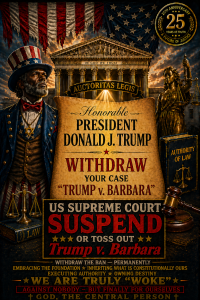
With profound respect, I write to request a temporary moratorium, suspension, or other appropriate restraint before final adjudication in Trump v. Barbara.
This request is not made to delay justice. It is made to ensure that justice proceeds upon a complete understanding of the very foundation upon which the present controversy rests.
The public debate surrounding this case has largely centered upon the words, “All persons born or naturalized in the United States…” Yet a prior and more fundamental question remains insufficiently examined: what role was intended for the Civil Rights Act of 1866, enacted only weeks before the proposal of the Fourteenth Amendment?
For generations, Americans have debated the lock while seldom examining the house to which the lock was attached.
The Civil Rights Act of 1866 was enacted in direct response to the condition of the formerly enslaved people emerging from the Civil War. It established citizenship, defined rights, created remedies, authorized federal enforcement, and sought to secure the practical enjoyment of liberty for a people long denied it. The Fourteenth Amendment followed shortly thereafter.
President Andrew Johnson’s veto messages reveal that he understood the extraordinary significance of that legislation. His objections repeatedly addressed the status of the freedmen, the powers being conferred, and the federal authority being vested in those whom the nation had previously held in bondage.
Yet over time, public attention drifted almost entirely toward the Amendment while the Act itself, with its detailed provisions and intended beneficiaries, receded into the background of public consciousness.
The result is a troubling possibility: that the nation may now be attempting to decide one of the most consequential citizenship questions in its history without first revisiting the very statute from which the debate arose.
If there exists even a reasonable possibility that the relationship between the Civil Rights Act of 1866 and the Fourteenth Amendment has been misunderstood, then prudence counsels education before adjudication.
The consequences are simply too significant to proceed otherwise.
As America commemorates its 250th year, we are presented with a rare opportunity to revisit unfinished questions arising from the Declaration of Independence, the Civil War, Reconstruction, and the continuing effort to secure liberty and equal citizenship under law.
This is not a request for a particular ruling.
It is a request for a national pause, a national examination, and a national conversation before a final judgment potentially shapes the understanding of citizenship for generations to come.
America has waited 160 years to revisit this debate.
A brief pause now may prevent generations of confusion later.
Accordingly, I respectfully urge this Court to consider a temporary moratorium, suspension, rehearing, or such other remedy as may be appropriate to permit fuller examination of the Civil Rights Act of 1866, its intended beneficiaries, its remedial powers, and its relationship to the Fourteenth Amendment before final adjudication.
Thank you for your consideration, your service, and your stewardship of the Constitution during this extraordinary moment in our nation’s history.
Respectfully submitted,
Ted Hayes
Founder, Justiceville
Mr. Citizen Patriot
Enclosure:
The Great 14th Amendment Moratorium Papers
Education Before Adjudication